

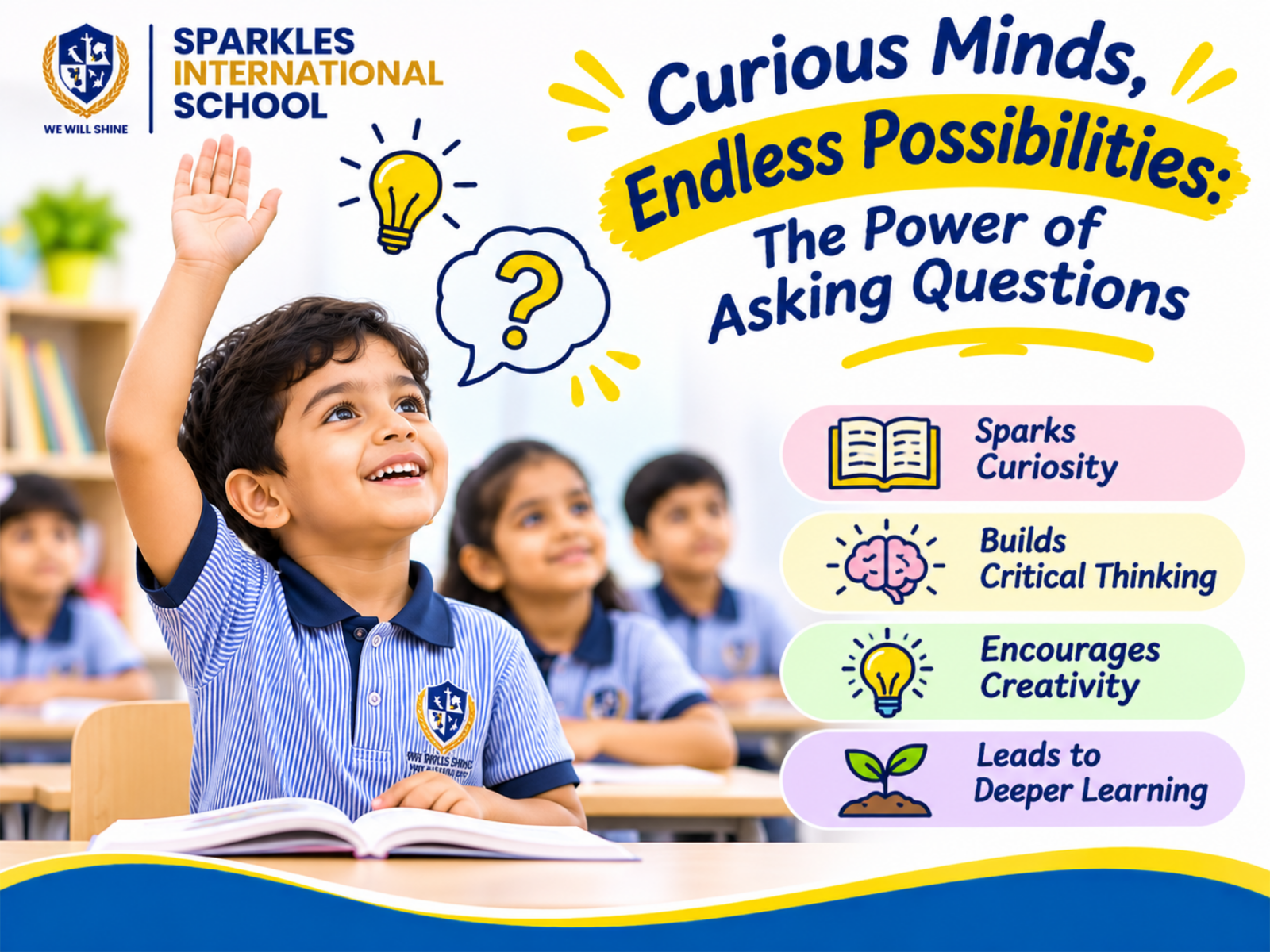
“Why is the sky blue?” “How do birds fly?” “Where does the rain come from?”
Childhood is filled with questions. Every little question reflects a growing mind trying to understand the world. A child’s curiosity is not just a sign of interest; it is the beginning of exploration, discovery and meaningful learning.
At Sparkles International School, we believe that every question deserves encouragement because curiosity opens the door to knowledge and helps children become enthusiastic learners.
Every Question Begins a New Discovery
Children naturally observe the things happening around them. They notice small details, explore unfamiliar objects and wonder how everyday things work.
When children are encouraged to ask questions, they begin to look beyond what they already know. Instead of simply accepting information, they become interested in understanding the reasons behind it.
Whether they are exploring nature, learning mathematics or discovering new scientific ideas, curiosity makes the learning process more engaging.
Simple Ways to Encourage Curiosity in Children
Parents and teachers can nurture curiosity through everyday experiences and meaningful conversations.
Explore Nature: Encourage children to observe plants, insects, clouds and changes in the weather.
Ask Open-Ended Questions: Questions such as “What do you think will happen?” encourage children to express their ideas.
Read Together: Storybooks introduce children to new places, characters and interesting possibilities.
Try Simple Experiments: Safe, age-appropriate experiments help children discover how things work.
Encourage Exploration: Give children opportunities to explore educational materials, puzzles and creative activities.
Appreciate Questions: Listen patiently and encourage children to continue asking and exploring.
How Curiosity Supports Children's Development
A curious mind develops several valuable abilities that support learning and everyday life.
Critical Thinking: Children begin to observe, compare information and think about possible answers.
Problem-Solving: They learn to explore different approaches when trying to understand something new.
Creativity: Asking questions encourages children to imagine possibilities and develop original ideas.
Communication Skills: Expressing questions and discussing answers helps children communicate more effectively.
Love for Learning: Discovering something new creates excitement and motivates children to explore further.
Let Children Think Beyond the Answers
Education should not be limited to memorising facts. Children also need opportunities to wonder, investigate and develop their own understanding.
When teachers welcome questions in the classroom, students feel more comfortable sharing their thoughts and participating in discussions.
Similarly, parents can support curiosity by giving children time to observe, explore and find answers rather than immediately answering every question.
Sometimes, asking a child “What do you think?” can be the beginning of a wonderful conversation.
Today's Questions Become Tomorrow's Discoveries
Every great discovery begins with curiosity. A simple question today may inspire a child’s interest in science, nature, technology, art or countless other possibilities tomorrow.
At Sparkles International School, we believe in creating meaningful learning experiences where children feel encouraged to ask questions, explore ideas and discover their individual strengths.
As we continue our commitment towards becoming the Best CBSE School in Gulbarga, our vision is to nurture curious thinkers, creative learners and confident individuals who are ready to explore the world.
Because a curious mind never stops learning, and every great journey begins with a question!
Sparkles International School – Inspiring Young Minds, Building Bright Futures!
Frequently Asked Questions
1. Why is curiosity important in childhood?
Curiosity encourages children to explore, ask questions, develop critical thinking and understand the world around them.
2. How can parents encourage curiosity at home?
Parents can read stories, explore nature, conduct simple experiments and welcome children’s questions.
3. How does curiosity improve classroom learning?
It encourages students to participate in discussions, explore new concepts and develop a deeper understanding of lessons.
4. What activities help develop curiosity in young children?
Nature walks, puzzles, storytelling, observation games, creative projects and simple science experiments can encourage curiosity.