

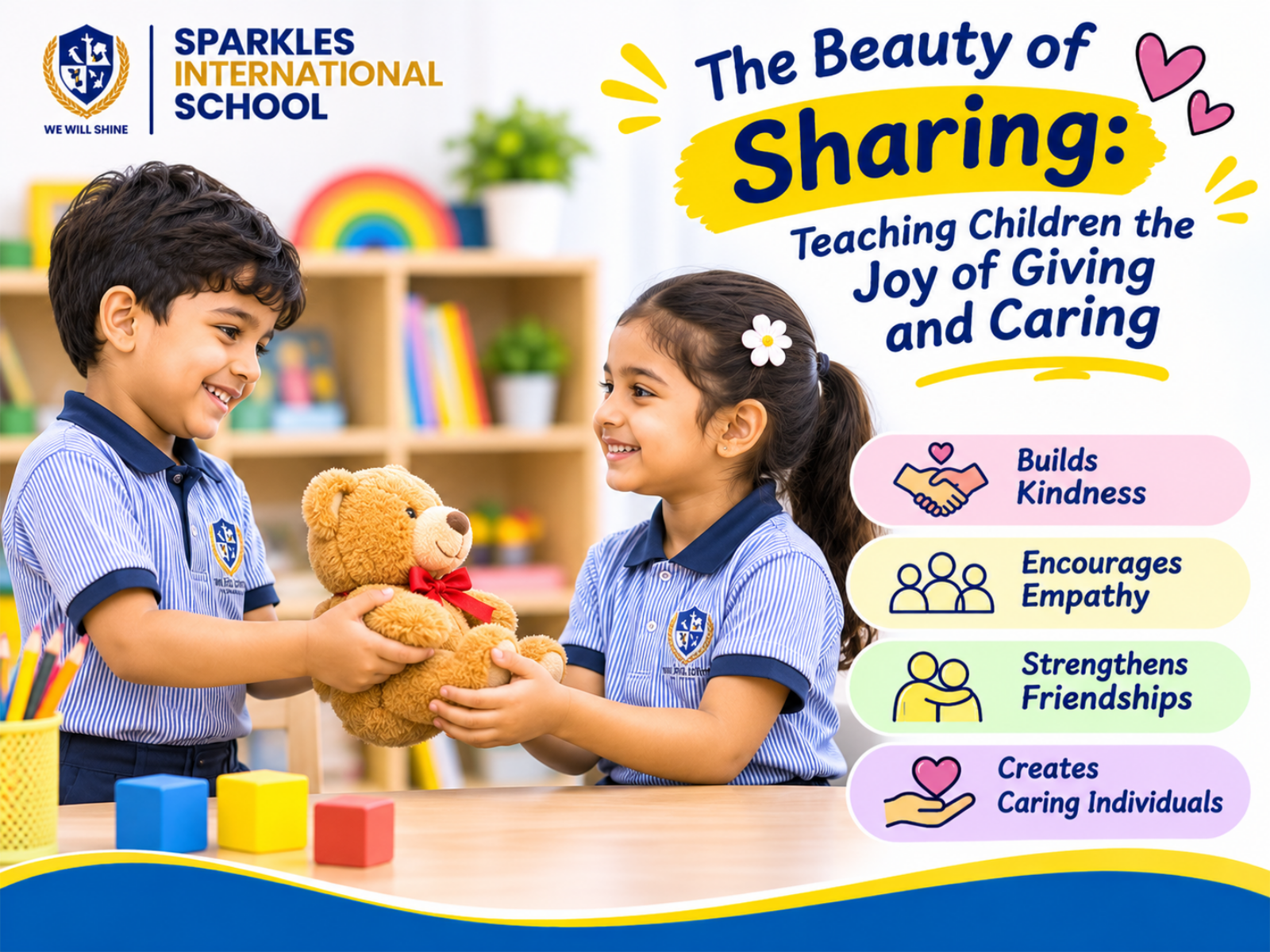
A favourite toy, a colourful crayon or a little piece of chocolate can mean so much to a child. But something even more beautiful happens when children learn to share these little things with others.
Sharing is one of the first important social values children learn during their growing years. It helps them understand kindness, caring, cooperation and the happiness that comes from making others smile.
At Sparkles International School, we believe that education is not only about academic knowledge but also about nurturing thoughtful, caring and responsible individuals.
Small Acts of Sharing Create Big Smiles
For young children, sharing does not always come naturally. They may feel attached to their favourite belongings or find it difficult to take turns. With gentle encouragement and positive examples, they gradually begin to understand that sharing can make playtime and friendships more enjoyable.
Simple experiences, such as sharing toys, exchanging crayons or offering help to a classmate, teach children that happiness becomes even more meaningful when it is shared.
Everyday Ways to Encourage Sharing
Parents and teachers can introduce sharing through small, enjoyable experiences in everyday life.
Sharing Toys: Encourage children to play together and exchange toys during playtime.
Taking Turns: Introduce simple games where everyone gets an opportunity to participate.
Sharing Food: Teach children the joy of offering and sharing food appropriately, while respecting allergies and dietary needs.
Helping Friends: Encourage children to help classmates with simple tasks.
Group Activities: Involve children in drawing, building and creative projects where they work together.
Appreciating Kindness: Recognise and appreciate moments when children show generosity and consideration.
What Children Learn Through Sharing
Sharing helps children develop important qualities that support their social and emotional growth.
Kindness and Empathy: Children begin to recognise the feelings and needs of others.
Cooperation: They learn how to participate in group activities and work together.
Friendship: Sharing creates opportunities for positive interactions and stronger friendships.
Respect: Children gradually understand the importance of considering other people’s needs and belongings.
Generosity: They discover that giving and helping others can bring happiness.
Parents and Teachers Are the Best Examples
Children often learn values by observing the people around them. When adults share, help others and treat people with kindness, children get positive examples to follow.
Instead of forcing children to share immediately, adults can guide them with simple words such as, “Would you like to let your friend have a turn?” or “Let’s enjoy this game together.”
It is equally important to teach children that sharing should be encouraged with respect for personal belongings and boundaries.
Growing Together Through Kindness
A child who learns to share also learns an important lesson about relationships: happiness is not only about what we receive but also about what we give.
At Sparkles International School, we believe that every little act of kindness contributes to building a caring and supportive learning environment.
As we continue our journey towards becoming the Best CBSE School in Gulbarga, we aim to nurture children who grow not only in knowledge and confidence but also in kindness, compassion and respect for others.
Because little hands that learn to share today can create a kinder world tomorrow!
Sparkles International School – Inspiring Young Minds, Building Bright Futures!
Frequently Asked Questions
1. Why is sharing important for young children?
Sharing helps children develop kindness, cooperation, empathy and positive social relationships.
2. How can parents teach children to share?
Parents can encourage sharing through family games, taking turns, group activities and positive examples.
3. At what age should children start learning to share?
Children can begin practising simple sharing and turn-taking during their toddler and preschool years with age-appropriate guidance.
4. How does sharing help children build friendships?
Sharing encourages cooperation, creates positive interactions and helps children understand the importance of caring for others.