

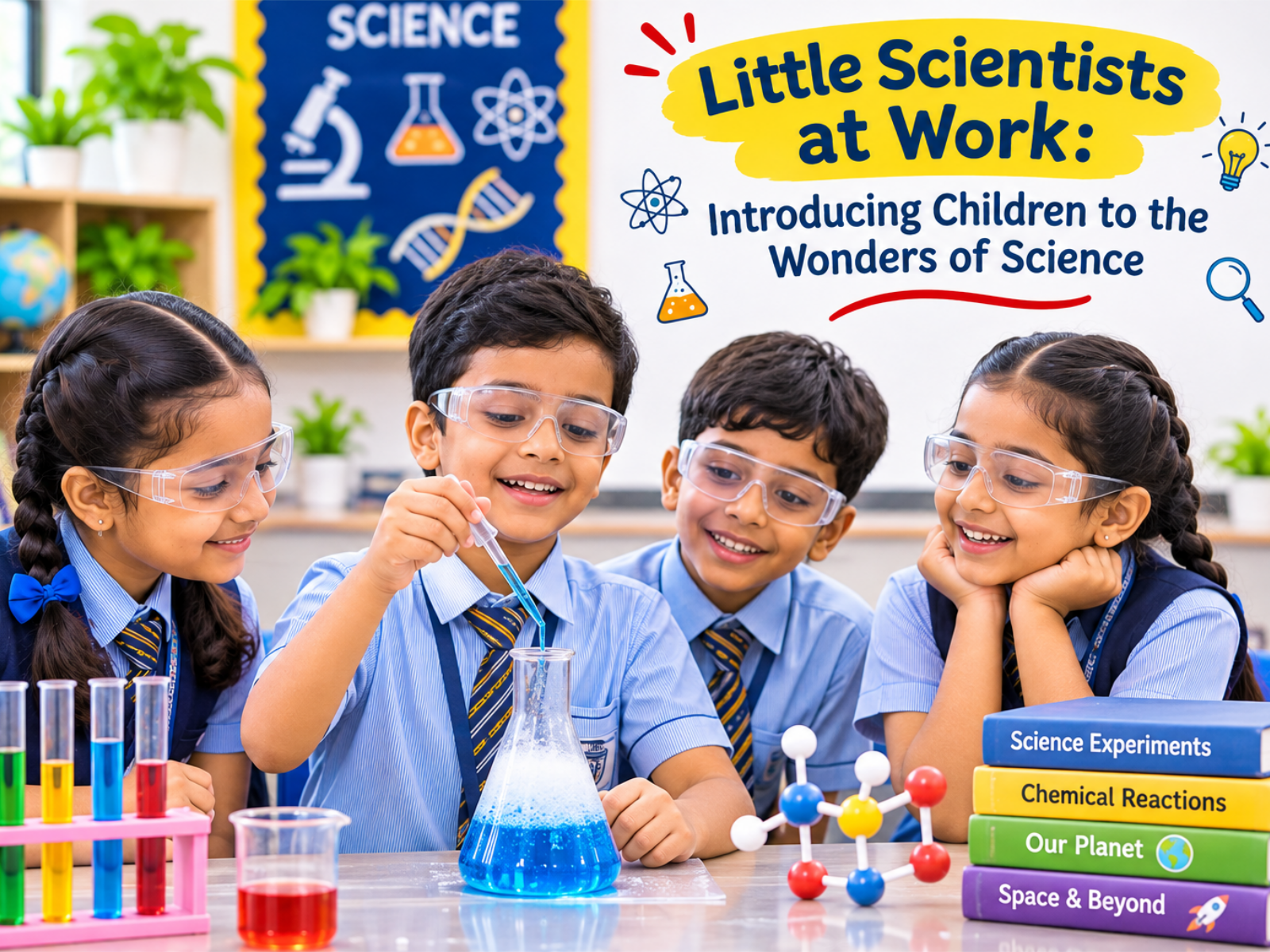
Science experiments for children can turn everyday questions into exciting discoveries. Why does ice melt? How does a shadow change? What happens when two colours mix? Simple experiments help children explore these questions and understand the world through practical experiences.
Science is not just about textbooks, laboratories or complicated formulas. It begins with observing, testing and discovering. When children get opportunities to experiment safely, they develop an interest in understanding how things work.
Why Should Children Explore Science from an Early Age?
Introducing science through simple experiences helps children connect what they learn with the world around them.
Early science activities can help children:
Understand basic scientific concepts.
Develop logical thinking and reasoning.
Learn to observe changes and patterns.
Become comfortable asking questions.
Develop an interest in discovery and experimentation.
Understand the importance of following instructions.
6 Simple Science Experiments Children Can Enjoy
With adult supervision and age-appropriate materials, simple experiments can make science exciting at home or school.
1. The Dancing Raisins Experiment
Place a few raisins in a clear glass of sparkling water. Children can observe how bubbles attach to the raisins and carry them upwards. When the bubbles disappear, the raisins sink again.
This experiment introduces children to the idea of gas bubbles and movement in liquids.
2. Exploring Colour Mixing
Take three transparent cups containing water. Add red, yellow and blue food colouring separately. Help children mix small amounts of different colours to see what new colours appear.
This activity introduces basic colour combinations through observation.
3. Watching Ice Melt
Place ice cubes in two separate plates. Keep one in a cool place and another in a warmer area under adult supervision. Ask children to observe which one melts faster.
They can learn that temperature affects how quickly ice melts.
4. Making a Simple Paper Boat
Fold a sheet of paper into a small boat and place it gently in a basin of water. Let children observe whether it floats. Discuss how the shape and material of an object can affect what happens in water.
5. Exploring Shadows
Place a toy or another safe object near a light source and observe its shadow on a wall. Move the object or light source and notice how the shadow changes.
Children can explore how light creates shadows.
6. Growing a Seed
Place a few beans between damp cotton in a transparent container. Keep the cotton moist and observe the changes over several days.
Children can record what they notice as the seed begins to grow.
How to Make Science Learning More Meaningful
The most valuable part of an experiment is not simply getting the expected result. It is helping children understand what happened and why.
Parents and teachers can make experiments more engaging by asking questions such as:
What do you think will happen?
What did you notice?
Why do you think this happened?
What changed during the experiment?
What would you like to try next?
Encourage children to describe their observations in their own words. There is no need to rush towards the correct scientific explanation. Give them time to think and share their ideas.
The Importance of Safety During Experiments
Science activities should always be suitable for a child’s age and abilities. Adult supervision is essential.
Use only safe, non-toxic materials.
Avoid experiments involving fire, heat or electrical appliances.
Never allow children to taste experimental materials.
Keep small objects away from young children who may put them in their mouths.
Clean up spills and wash hands after activities.
Safety should always come before experimentation.
Creating a Love for Science at School
Children often become more interested in science when they can see concepts demonstrated rather than only reading about them.
At Sparkles International School, we believe that practical learning opportunities can make academic concepts more engaging and meaningful. Science exploration encourages children to observe carefully, think logically and appreciate the discoveries that happen around them.
As we continue our journey towards becoming the Best CBSE School in Gulbarga, we value learning experiences that encourage young minds to explore, experiment and develop a lasting interest in knowledge.